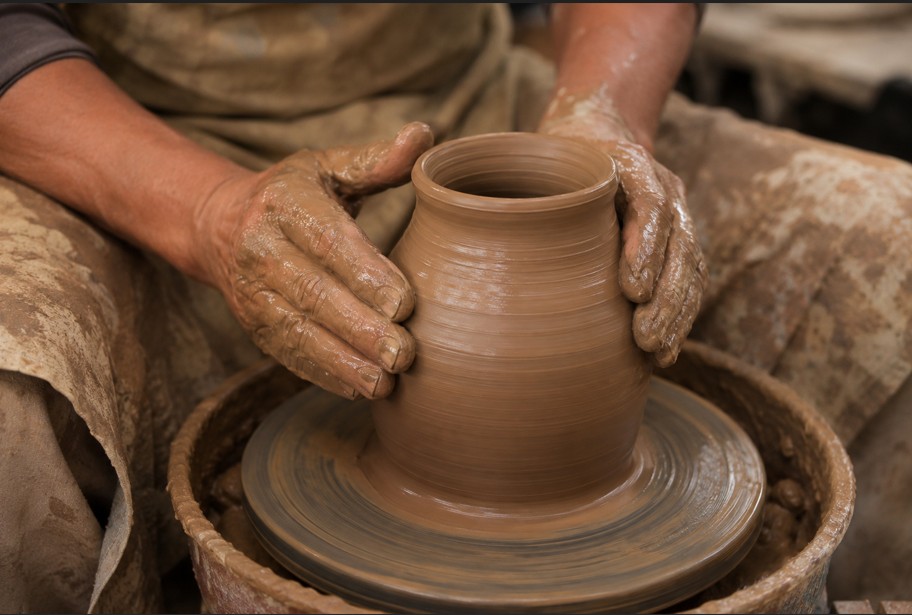
There is a powerful image in Scripture that speaks directly to the heart of spiritual formation. The image of the Potter and the clay.
In Jeremiah 18:1-6, the prophet is invited to observe something simple, yet profound:
“This is the word that came to Jeremiah from the Lord: ‘Go down to the potter’s house, and there I will give you my message.’ So I went down to the potter’s house, and I saw him working at the wheel. But the pot he was shaping from the clay was marred in his hands; so the potter formed it into another pot, shaping it as seemed best to him. Then the word of the Lord came to me. He said, ‘Can I not do with you, Israel, as this potter does?’ declares the Lord. ‘Like clay in the hand of the potter, so are you in my hand, Israel.’”
This is not just a picture of God’s authority—it is a picture of His intentional, patient, and redemptive work in us.
The clay does not shape itself. It does not determine its own form. It is shaped by the hands of the Potter. And when it becomes marred, the Potter does not discard it, He reshapes it.
This is the heart of restoration: God forming His image in us as we submit to His hand.
But here is where the tension lies, while God is the one who shapes, we are the ones who must remain yielded on the wheel.
Training for Godliness:
The Apostle Paul speaks directly into what that yielded life looks like in 1 Timothy 4:7-8:
“Have nothing to do with godless myths and old wives’ tales; rather, train yourself to be godly. For physical training is of some value, but godliness has value for all things, holding promise for both the present life and the life to come.”
Notice the language: train yourself.
Spiritual growth is not accidental. It is not passive. It is not something that happens apart from our participation. Just as an athlete trains their body through repetition and discipline, we are called to train our lives toward godliness.
This is not about striving to earn God’s love. It is about responding to His love by positioning ourselves to be shaped by Him.
Every time we choose prayer over distraction, Scripture over noise, obedience over comfort, we are stepping back onto the wheel and allowing the Potter to continue His work.
We are not forming ourselves. But we are choosing whether or not to submit to the forming.
A Life of Surrendered Discipline:
Paul deepens this idea with even stronger language in 1 Corinthians 9:27:
“No, I strike a blow to my body and make it my slave so that after I have preached to others, I myself will not be disqualified for the prize.”
This is the language of surrender and self-mastery.
Paul recognizes that there are desires, habits, and impulses within us that resist the shaping hand of God. Left unchecked, they pull us away from the very life God is forming in us.
So what does Paul do? He brings his life into alignment. He refuses to be led by anything other than his submission to God.
This is not harshness, it is clarity. It is understanding that if we are not intentional, we will drift. If we are not disciplined, we will resist. And if we are not surrendered, we will become hardened to the very work God desires to do in us.
Spiritual discipline, then, is not about control for its own sake—it is about remaining soft, responsive, and centered in the hands of the Potter.
The Power to Yield: The Help of the Holy Spirit
It’s important to understand something clearly:
Submitting to the Potter’s hand is not something we accomplish in our own strength.
Jesus Himself addressed this when He spoke to His disciples about the coming of the Holy Spirit in John 14:16-17:
“And I will ask the Father, and he will give you another advocate to help you and be with you forever—the Spirit of truth. The world cannot accept him, because it neither sees him nor knows him. But you know him, for he lives with you and will be in you.”
And again in John 16:13:
“But when he, the Spirit of truth, comes, he will guide you into all the truth…”
Jesus makes it clear—the Christian life is not lived alone.
We are not left to force ourselves onto the wheel or to somehow manufacture transformation.
Instead, we are given the Helper, the Comforter, the Holy Spirit.
He works within us in quiet but powerful ways:
Gently convicting us when we drift.
Reminding us of truth when we forget.
Drawing us back when we resist.
Strengthening us when we feel weak.
Even our desire to return to God is evidence of His work in us.
So when we talk about spiritual disciplines: prayer, scripture, fasting, submission and obedience, we are not talking about human effort alone. We are talking about Spirit-empowered responses.
We don’t force ourselves onto the wheel.
We are drawn there by the Spirit and sustained there by His power.
As we respond to His prompting, something begins to change. Our hearts soften. Our desires shift. Our lives begin to align.
Because the same Spirit who calls us to the wheel also gives us the power to remain there.
A Gentle Invitation to the Wheel
The beauty of this truth is that God is not distant in this process. He is near. He is patient. And He is committed to completing the work He has begun.
Even when the clay is marred, even when we fall short, grow distracted, or resist His leading. He does not walk away. He reshapes. He restores. He continues.
This is not a call to perfection. It is a call to submission.
A call to return.
A call to place ourselves once again on the wheel and trust His hands.
So wherever you find yourself today—steady or struggling, consistent or drifting—know this:
You are still in the Potter’s hands.
And His desire is not to condemn you, but to restore His image in you.
So come back to the wheel.
Sit in His presence.
Open His Word.
Respond in obedience.
Not out of pressure, but out of trust.
Because the same hands that formed you are faithful to reshape you.
And He is not finished yet.
-Timothy Rapp
 KINGDOM LIFE AZ
Leave a comment